
Retail Investors vs. Institutional Money: Who’s Winning Right Now?
Important Disclaimer: This article is for informational purposes only and does not constitute financial advice. This content covers topics that may significantly impact your finances. Always consult qualified financial advisors for advice specific to your situation.
The battle between retail investors and institutional money has never been more interesting than it is right now. A decade ago, the answer to who was winning would have been obvious: the big players with their algorithms, research teams, and massive capital reserves dominated every corner of the market. But something shifted.
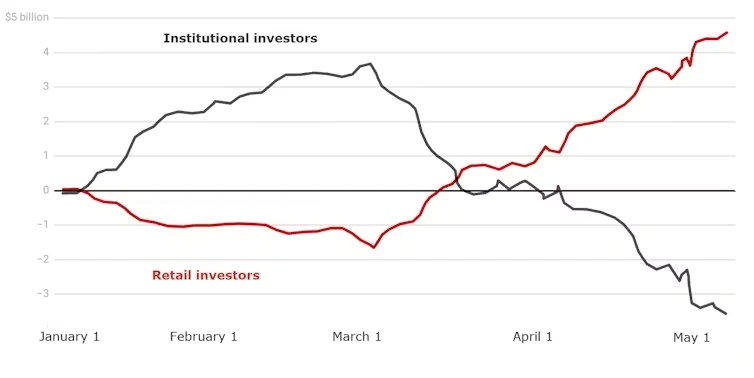
Retail investors now account for 20-25% of daily U.S. equity trading volume, doubling their share from just ten years ago. That’s not a blip or a meme stock frenzy hangover. It represents a fundamental change in how markets operate.
I’ve watched this transformation unfold through countless conversations with both individual traders and fund managers. The institutional crowd still controls the lion’s share of assets, but their dominance isn’t what it used to be. Meanwhile, retail traders have developed new strategies, better tools, and a collective voice that can move markets in ways that seemed impossible before 2020.
So who’s actually winning right now? The answer is more nuanced than either side wants to admit. Both groups have distinct advantages, and the real question might be whether “winning” even means the same thing to a hedge fund manager and someone trading from their phone during lunch breaks.
Table of Contents
Toggle
- Key BenefitsPrimary AdvantagesUse Cases
- How It Works
- Getting Started
- Consider consulting a financial advisor to develop a strategy that fits your specific situation. Past performance never guarantees future results, and investments always carry risk. But understanding this competitive landscape helps you make more informed decisions about where your money belongs.
Key Benefits
Understanding what each group brings to the table helps explain why this competition has become so compelling. The advantages on both sides are real, and they’re shifting in interesting ways.
Primary Advantages
Institutional investors still hold cards that individual traders simply cannot match. They have access to private placements, pre-IPO deals, and direct relationships with company management. Their research departments employ analysts who spend entire careers studying single industries. When a pension fund wants to understand semiconductor supply chains, they can fly to Taiwan and tour factories.
But retail investors have developed their own edge. Speed and flexibility matter more than ever in volatile markets. A retail trader can exit a position in seconds without worrying about moving the market or explaining the decision to an investment committee. There’s no quarterly performance review, no benchmark to beat, no client calls to return.
The information gap has also narrowed dramatically. Regulatory changes mean material information must be disclosed publicly, and social media allows retail investors to share insights instantly. Real Finance Tips has observed that individual investors often spot consumer trends months before they show up in institutional research reports, simply because they’re living those trends daily.
Use Cases
The practical applications differ significantly between these groups. Institutional money excels at patient, long-term positioning in illiquid assets. Private equity, venture capital, and real estate investment trusts require capital that can be locked up for years. Most retail investors cannot and should not tie up their money this way.
Retail investors shine in nimble, opportunistic plays. When a company announces unexpected news after hours, individual traders can react immediately while institutional investors wait for compliance approval. The meme stock phenomenon demonstrated this perfectly: retail coordination moved faster than institutional risk models could process.
According to recent data, approximately 60% of retail investors use mobile trading apps as their primary investment platform. This mobile-first approach enables real-time decision making that institutional processes simply cannot match.
How It Works
The mechanics of how each group operates reveal why their competition has intensified. Understanding these differences helps explain recent market dynamics.
Institutional investors operate within rigid frameworks. A mutual fund manager must stay within their stated mandate: a large-cap growth fund cannot suddenly pivot to small-cap value stocks, even if the opportunity seems obvious. Compliance teams, risk committees, and regulatory requirements create layers of oversight that slow decision-making but also prevent reckless behavior.
The capital flows tell an important story. Retail investors contributed approximately $302 billion in inflows into U.S. stocks in 2025, representing a 53% increase from $197 billion in 2024. That’s serious money entering the market from individual accounts, and it’s changing price discovery in meaningful ways.
Institutional sentiment reveals a different picture. 74% of institutional investors surveyed believe the markets are due for a correction, yet they cannot simply move to cash. Their mandates require them to stay invested, which creates an interesting tension: professional money managers are worried while continuing to deploy capital because their job descriptions demand it.
This structural difference matters. Retail investors can go to 100% cash tomorrow if they choose. Institutions cannot. When corrections do arrive, this flexibility becomes either a massive advantage or a temptation toward panic selling, depending on the individual investor’s discipline.
Getting Started
For those looking to understand where they fit in this landscape, a few realities deserve honest consideration.
First, recognize what you’re actually competing against. Institutional investors have advantages in information processing, execution quality, and staying power during drawdowns. Fighting them on their turf rarely ends well. The retail investors who succeed tend to exploit areas where size becomes a disadvantage: small-cap stocks, rapid sentiment shifts, and situations where being able to act quickly matters more than having deep pockets.
Real Finance Tips recommends that individual investors focus on their genuine edges rather than trying to replicate institutional strategies. You probably cannot build a better quantitative model than Renaissance Technologies. But you can understand why your teenager’s friends suddenly all want a particular product before any analyst writes a report about it.
The tools available to retail investors have improved dramatically. Commission-free trading, fractional shares, and sophisticated charting platforms were institutional-only features a generation ago. Use them, but understand their limitations. Free trading encourages overtrading, and easy access to options has cost many retail investors dearly.
Nearly two-thirds of U.S. institutional investors say active strategies will be favored in 2026, suggesting they expect volatility that rewards stock picking over passive indexing. Retail investors should consider whether they have the time, knowledge, and emotional discipline to play that game, or whether capturing market returns through low-cost index funds remains the smarter approach for their situation.
Building genuine knowledge in specific areas beats trying to know everything. An engineer who understands semiconductor manufacturing has real insight into chip stocks. A nurse who sees which medical devices actually work has information no analyst report contains. These edges are real, legal, and underutilized by most retail investors.
Risk management separates successful retail investors from the majority who underperform. Position sizing, diversification, and knowing when to admit you’re wrong matter more than finding the next big winner. Institutional investors have risk departments enforcing these disciplines. Individual investors must enforce them on themselves.
The question of retail investors versus institutional money doesn’t have a simple winner. Both groups have adapted to each other’s presence, and the market has changed as a result.
Retail investors have gained ground in ways that seemed impossible a decade ago. Their collective capital moves markets, their information access has improved dramatically, and their flexibility provides genuine advantages in certain situations. The doubling of retail trading volume share represents a structural shift, not a temporary phenomenon.
Institutional investors retain significant advantages in resources, staying power, and access to certain opportunities. But their dominance is no longer absolute, and smart money managers have learned to respect retail sentiment as a market force.
For individual investors reading this, the honest answer is that you’re probably not “winning” against institutions in a direct competition. But you don’t have to. Your goals, timeline, and risk tolerance are different. The retail investor who builds wealth steadily over decades through disciplined investing has won their own game, regardless of what hedge funds are doing.
Consider consulting a financial advisor to develop a strategy that fits your specific situation. Past performance never guarantees future results, and investments always carry risk. But understanding this competitive landscape helps you make more informed decisions about where your money belongs.
This article is for informational purposes only and does not constitute financial advice.